
"Not All Christians" Functions the Same Way as "Not All Men"
We don't get to separate ourselves entirely.

One thing I have been seeing more and more on the interwebs is the sentiment of “Not all Christians”. It almost always arrives when someone is trying to talk about something systemic. Someone says Christianity in America has become fused with nationalism, whiteness, racism, empire, abuse, cruelty, petty grievance, greed, and authoritarianism, and immediately a chorus emerges like cicadas after rain: Not all Christians. Which is technically true in the same way that saying not all cigarettes cause cancer is technically true.
This should be familiar because it operates almost identically to “Not all men.” This appears when a woman says online that she’s exhausted by the way men behave around sex, entitlement, violence, emotional illiteracy, or whatever, and before she can even finish the sentence, some guy who acts like a customer service employee for toxic masculinity leaps into the comments to assure everyone that he personally has never murdered anyone in an alley. The discussion instantly shifts away from the issues and toward the preservation of accuracy. The institution of masculinity ends up barely touched because every critique is treated as a personal accusation.
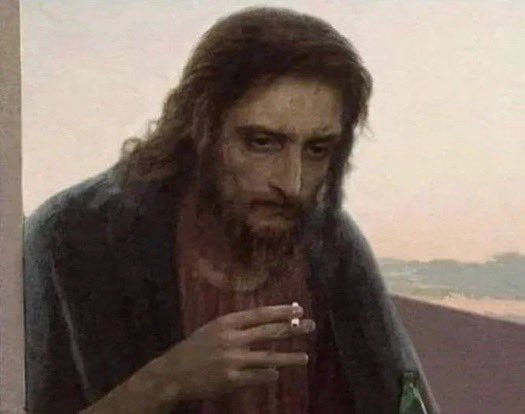
This is revealing in itself. Because if someone says “teachers are underpaid” and you do not happen to be a teacher, you generally do not feel compelled to burst through the wall Kool-Aid-Man-style screaming “I AM ALSO UNDERPAID.” The defensive reaction usually signals identification with the criticized thing. Or worse: dependence upon it.
Which is why “Not all Christians” tends to appear most urgently whenever Christianity’s public witness becomes especially grotesque. Children in cages. Book bans. Prosperity gospel charlatans buying private jets while poor people tithe themselves into insolvency. Pastors treating empathy like a demonic ploy. Legislators invoking Christ while cutting food assistance to children. Crowds roaring with delight at cruelty. Somebody points at this and says maybe there is something spiritually diseased happening inside American Christianity, and immediately comes the response: Well MY church isn’t like that.
And okay. Maybe your church serves soup on Wednesdays and has a lovely retired lesbian couple arranging flowers in the vestibule and a pastor who owns several Richard Rohr books. Fine. Wonderful. But if your first instinct when confronted with systemic critique is to litigate your own individual purity, then you are still centering yourself over the people harmed by the larger structure.
This is why the phrase also resembles “All Lives Matter” so terribly. “Black Lives Matter” was a specific cry emerging from specific historical violence. It was not saying only Black lives matter. It was saying the society demonstrably behaves as though Black lives matter less. “All Lives Matter” functioned as a way to flatten the critique into abstraction so nobody has to address the actual imbalance of power. Universalizing language can become a distraction. It scrubs violence from history through vagueness.
Likewise, “Not all Christians” often works to dissolve public accountability into individual exceptions. The point of the critique is not that every Christian is personally malicious. The point is that Christianity as a dominant political and cultural force in America has attached itself to systems of domination.
It is one of the worst habits in liberal modern American Christianity; the insistence that anything embarrassing somehow does not count as “real Christianity.” Every atrocity becomes an outsourcing problem. Crusades? Not real Christians. Segregationists quoting scripture? Not real Christians. Prosperity gospel televangelists? Not real Christians. Christian nationalists? Not real Christians. At a certain point you have to wonder whether real Christianity exists at all or whether it is just an endless game of a whack-a-mole where every manifestation gets disowned the moment it produces consequences.
Donald Trump is maybe the clearest example of this phenomenon. People desperately want him to represent some external corruption of Christianity rather than a logical expression of certain American Christian tendencies...
